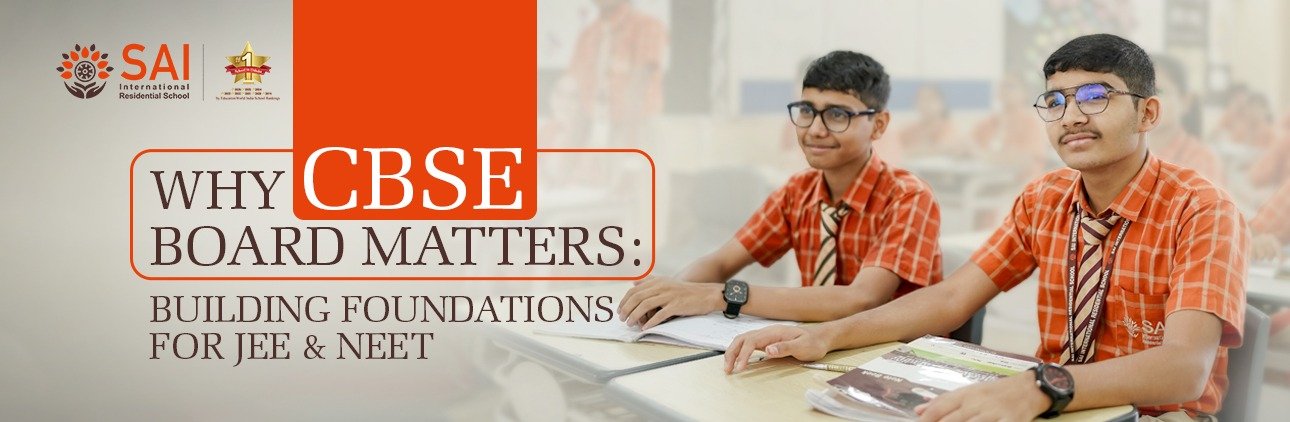
CBSE matters for JEE and NEET aspirants because its syllabus is closely aligned with the NCERT textbooks that both entrance exams are based on, which means students preparing well for their boards are, by default, building the same foundation they need for these competitive exams. This is one of the clearest CBSE board advantages over other curricula.
What Makes the CBSE Curriculum Effective for Competitive Exams
Not every board syllabus maps onto JEE and NEET the way CBSE's does. The best CBSE curriculum design isn't just about covering topics — it's about how closely those topics mirror what shows up in the entrance papers later. Since JEE and NEET question papers draw heavily from NCERT content, a student who has genuinely understood their Class 11 and 12 CBSE syllabus isn't starting from scratch when competitive exam prep begins. They're extending what they already know.
At SAI International Residential School, the academic programme follows the CBSE pattern with an emphasis on active learning — students are encouraged to explore, question and apply concepts rather than just memorise them. That habit of thinking things through, rather than just recalling facts, tends to matter more in JEE and NEET than most people expect, since both exams reward conceptual clarity over rote learning.
CBSE Board Advantages for JEE Preparation
JEE preparation works best when board studies and exam prep aren't pulling students in two directions. Some of the practical advantages CBSE offers here:
• A syllabus that overlaps significantly with the JEE Main and Advanced pattern, particularly in Physics, Chemistry and Maths.
• Regular internal assessments that build the habit of solving problems under time pressure — a skill JEE tests directly.
• A structured Class 11–12 progression that lets PCM students build depth over two years instead of cramming everything into a single year.
None of this replaces dedicated JEE coaching, of course. But it does mean the two aren't working against each other — a student's board revision genuinely feeds into their entrance prep, rather than being a separate, competing syllabus to juggle.
How CBSE Supports NEET Readiness
NEET readiness depends heavily on Biology, Chemistry and Physics fundamentals — and again, this is where the NCERT-CBSE alignment does a lot of quiet, unglamorous work. A student who's thorough with their CBSE Biology and Chemistry textbooks is already covering a large chunk of the NEET syllabus.
What tends to separate a good NEET attempt from an average one isn't extra material — it's how well a student has retained and can apply what's already in the NCERT books. CBSE's structured assessment pattern, with its periodic tests and practical components, gives students regular checkpoints to see where their understanding is actually solid versus where it just feels solid.
Beyond the Curriculum: Coaching and Mentoring Support at SAI International Residential School
A good curriculum is the starting point, not the whole story. What happens after school hours often matters just as much. At SAI International Residential School, additional academic support is built into daily life rather than left to chance — the school runs regular coaching for entrance examinations including JEE, NEET, SAT and CLAT, delivered in partnership with established coaching organisations, alongside stream-specific coaching and early morning classes for students who need extra time with certain topics.
For boarding students, this structure has a practical advantage that day scholars sometimes miss out on: there's no commute eating into study time, and the daily routine — classes, coaching, prep, rest — is already built around exam goals rather than squeezed in around them. Combined with a study schedule and personal mentoring through the school's Career Connect programme, students get guidance not just on what to study, but how to pace themselves across two demanding years.
The SIRS Track Record
Numbers don't tell the whole story, but they're worth including here since they're grounded in the school's own recent results. In the CBSE Class XII Board Examinations 2026, SAI International Residential School recorded a school average of 87.23%, with 19.7% of students scoring 95% and above and 39.8% scoring 90% and above. Jayesh Agrawal led the Science stream with 94% — the stream most directly relevant to JEE and NEET aspirants.
Beyond board results, over 450 SAIoneers have gone on to top engineering colleges and over 275 to top medical colleges worldwide, alongside 100+ who've made it to institutions like NISER, ISRO-linked programmes and universities abroad. These aren't projections — they're the kind of outcome data that a genuinely CBSE-aligned, exam-aware academic structure tends to produce over time.
Conclusion
Put simply, CBSE's strength for JEE and NEET aspirants comes down to alignment — its syllabus, its NCERT grounding, and its assessment style all point in the same direction as the entrance exams themselves. That's not a small thing. It means a student's day-to-day board preparation isn't wasted effort once competitive exam season arrives; it's the same foundation, built continuously.
This is exactly where SAI International Residential School fits into the picture. It doesn't just follow the CBSE board — it builds its daily academic rhythm, its coaching partnerships for JEE, NEET, SAT and CLAT, and its residential structure around making that curriculum count for something beyond the boards themselves. For a family in Bhubaneswar or anywhere in the wider Odisha region weighing up a CBSE school in Bhubaneswar, that combination of a strong CBSE foundation, structured entrance-exam coaching, and a boarding environment built around study discipline is worth serious consideration — and the school's own 2026 board results and long-term career outcomes suggest it's a combination that's actually working.