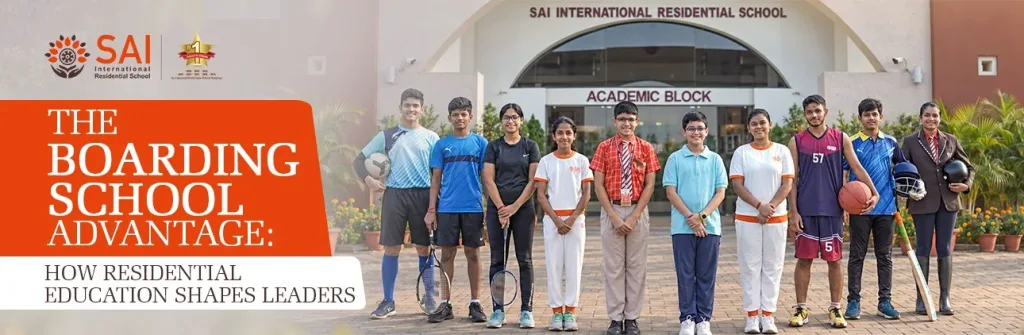
Boarding school shapes leaders mainly through daily practice, not lectures — students manage their own time, take responsibility for their belongings and choices, and work within group systems like houses and clubs that put them in charge of something bigger than themselves, again and again, until it becomes habit. This is the core of what people mean by boarding school advantages, and residential schools like SAI International Residential School build their entire daily structure around it.
What Are the Real Boarding School Benefits?
It's easy to reduce boarding school benefits to a list of facilities, such as good hostels, sports grounds, and libraries, but the more interesting benefit is less visible. It's the sheer number of small decisions a boarding student makes every single day that a day-school student, going home each evening, simply doesn't have to.
What time to start homework, how to resolve a disagreement with a roommate, whether to join the debate club or the astronomy club this term — none of these are dramatic choices on their own, but they add up over years into something that looks a lot like leadership readiness.
At SAI International Residential School, this shows up in the actual structure of daily life. Students follow a set routine, but within that routine, they're the ones making the calls — which is really the whole point.
Boarding School Benefits That Build Leaders
Leaders aren't made in lectures. They're shaped by small moments that repeat every day. These are the boarding school benefits that matter most:
• Responsibility — Children look after their own belongings and answer for their own behaviour. Nobody quietly cleans up after them.
• Time management — Fixed study hours, meals and activity slots teach planning. If homework slips, the child feels it, and that's a useful lesson.
• Teamwork — Sharing a space means settling disagreements and giving a little. Over time, children learn patience and how to work with people they didn't choose.
• Speaking up — House roles, clubs and councils give children a chance to lead small groups long before they enter a workplace.
• Resilience — A rough first week, a bad exam, a lost match. Children learn to get through these with support close by, rather than being rescued instantly.
How Boarding School Builds Everyday Independence?
Student independence doesn't usually arrive as a big moment. It builds up through repetition. In residential schools,
• Students are trained to make independent decisions in a balanced way and to take ownership of those decisions.
• Students are taught to look after their own belongings and be responsible for their own behaviour — which sounds small, but is exactly the kind of thing that gets skipped when a parent is nearby to sort things out.
• Constant, disciplined routine helps students become punctual and reliable, not because they're told to be, but because the structure quietly expects it of them.
None of this happens overnight, and it isn't meant to. It's cumulative — a student who's spent a few years managing their own schedule and belongings simply isn't starting from zero when bigger responsibilities come along later.
How House Life at SIRS Turns Everyday Activities into Leadership and Personality Development?
If independence is the individual side of things, house life is where it turns social. SAI International Residential School runs four houses — Dhvaja (Red), Srivatsa (Yellow), Vajra (Blue) and Chakra (Green) — and students earn house points across academic, extra-curricular and pastoral activities, competing in quizzes, sports and subjects ranging from debating to music.
What makes all this relevant to leadership isn't the competitions themselves; it's what competing as part of a house actually requires. Someone has to organise the team, someone has to keep others motivated after a loss, someone has to figure out who's good at what. Over a school year, most students end up doing at least one of those jobs, whether or not anyone calls it "leadership" out loud.
Other than what happens organically through hostel and house life, SAI International Residential School also runs structured personality development programmes, aimed at building the kind of practical confidence students will need well beyond school. These include group discussions, presentations and workshops covering areas like stress management, communication skills and interpersonal relationships, along with mock interviews designed to help students handle real-world questioning without freezing up.
The Safety, Structure and Support Behind It All
None of this independence-building works without a genuinely safe environment behind it — and this is the part that's easy to overlook when talking about leadership and growth. SIRS maintains CCTV coverage across the campus, fire warning systems, and round-the-clock guards and wardens, along with in-house doctors and tie-ups with city hospitals for anything beyond routine care. Boys' and girls' hostels are kept separate, each with its own House Masters and Wardens.
Conclusion
Put together, the boarding school advantage isn't really one single thing — it's independence built through daily routine, leadership practiced informally through house life, character work done on purpose through structured programmes, and all of it resting on a safe, well-supervised environment that lets students actually take those risks without real ones attached.
This is where SAI International Residential School fits the picture closely. As a residential school Bhubaneswar-area families have increasingly considered over the years, it brings together the everyday structure that builds independence, a house system that turns ordinary activities into small leadership tests, dedicated personality development programmes, and the safety infrastructure that makes all of it possible without constant anxiety at home. For a family trying to figure out whether residential education is worth it, the honest answer is that the value shows up less in any single feature and more in how consistently all of these pieces work together over years — which is exactly the environment SIRS has built its daily life around.