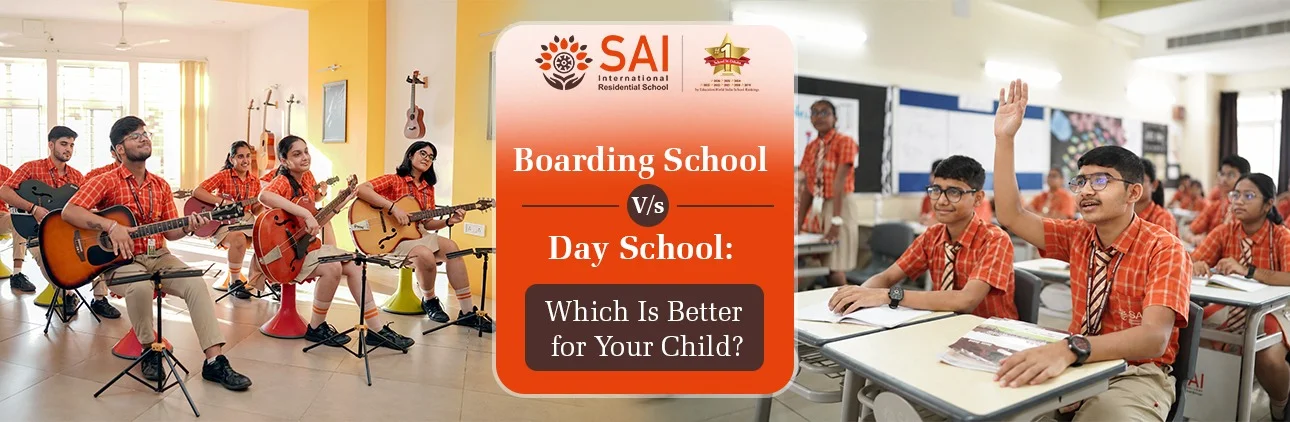
At some point, almost every parent wonders whether to send their child to a boarding school or keep them at home and pick a day school nearby. It’s a big decision, as you’re not only choosing classrooms; you’re choosing who looks after your child in the evenings, who they spend their time with, and how much of their growing up you get to see. There’s no answer that works for every family, so let’s look at what actually changes.
In the boarding school vs day school debate, there’s no winner for every child. A boarding school suits children who are ready to live away from home and follow a routine. A day school suits children who need home each evening. Thus, when making a decision, you should choose based on your child’s age and temperament.
What’s the Difference Between Boarding and Day School?
A day school is the one most of us grew up with. A child goes in the morning, comes home in the afternoon, and the evening belongs to the family. In a boarding school, children live on campus during the term, and the school plans the meals, study time, sleep and activities.
In India, you’ll often hear “residential school” used for the same thing, so the residential school vs day school question is really the same one. Most boarding schools send children home for the holidays, and some allow visits or weekends at home, depending on the school.
Boarding School vs Day School: Side by Side
Here’s how the two compare in everyday life.
Boarding school
Day school
Daily routine
The school plans the whole day, from waking up to lights out
The school day ends with the bell, and the evening is up to the family
Supervision
Trained hostel staff look after the evenings and nights
Parents look after the evenings
Study help
Supervised study hours and teachers close by
Homework help comes from home or tuition
Independence
Children learn to manage their time and belongings earlier
Learned more slowly, with parents nearby to step in
Family time
Holidays, calls and visits
Every evening
Travel
No daily commute
Can take two or three hours a day
Cost
Usually higher, since it covers stay, food and care
Usually lower, but tuition, travel and extra classes add up
When you compare costs, look at the full package, not just the tuition. And with boarding, always ask who the hostel staff are and how many look after the children.
Boarding School Benefits Parents Value Most
When a boarding school is run well, these boarding school benefits tend to show up.
• A steady routine. Fixed times for meals, study and sleep help children become punctual and organised, and they usually sleep better for it.
• Early independence. Looking after their own belongings and managing a schedule teaches responsibility in a way that lectures don’t.
• Study help close by. A doubt can be cleared with a teacher or a friend that same evening, not the next morning.
• Friendships that go deep. Living with other children means sharing space, settling arguments and learning to get along.
• More room for activities. Sports, music, art and clubs fit into the hours that would otherwise go on travel and TV.
Where a Day School Does Better
Day schools have real strengths, and it’s worth being fair about them. Younger children, in particular, often need the comfort of home every evening. You’ll notice sooner if your child is upset, having trouble with a friend, or just tired. There’s also no adjustment period. If your child has never spent a night away from the family, pushing boarding too early can backfire. And if there’s a good school near your home, a day school simply makes practical sense.
Questions to Ask Before You Decide
Instead of asking which type is better, ask a few questions about your own child, such as:
• How does your child cope when you’re away? A week with relatives can tell you a lot.
• Is the child excited about boarding, or are you the ones pushing the idea?
• Who looks after the hostel at night, and what happens if a child falls ill?
• What do the meals look like, and who plans them?
• How often can you call, visit or bring your child home?
• Does the school’s academic plan match your goals?
Conclusion
So, which is better? Well, it depends. A day school keeps your child close and works well for younger children and families who want everyday involvement. A boarding school gives structure, independence and extra study and activity time, and works best for a child who’s ready. Ultimately, the right choice is the one that fits your child, not the one that sounds more impressive.
If boarding is on your list, here’s how we approach it at SAI International Residential School. We’re a CBSE school, and boys and girls live in separate hostels, looked after by house masters and house wardens. Guards and wardens are on duty around the clock; the campus has CCTV and fire warning systems, and students don’t leave campus without prior permission. If a child is unwell, our in-house infirmary has doctors and trained nurses; we have an ambulance for hospital visits, and parents are informed straight away. Every student has a health card, and we hold regular health checkups. You can read more about safety and security and hostel life on our website.
Day-to-day, each student has a private space and a study schedule. We hold evening classes daily and early-morning remedial classes for children who need extra help. We also offer coaching for entrance exams such as SAT, NEET, JEE and CLAT. Meals are prepared by a professional caterer under a qualified nutritionist, and we run yoga and meditation classes every day. Our Wellness Counsellor is there for students who need support. Beyond classes, children can use the library, swimming pool, music, dance and art rooms and join clubs. A house system rewards effort in academics, activities and conduct, which helps children build confidence and responsibility.
If you’d like to know more about the school, then you may as well see the campus for yourself with our virtual tour, or send us an admission enquiry, and we’ll help you decide whether boarding is right for your child.